
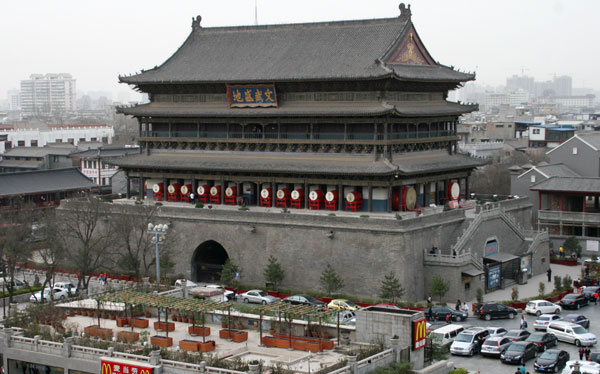
Xi’an, a city full of history and culture, dates back to a million years ago when 13 dynasties established their capital here in the 11th century BC. To the Tang Dynasty (618-907). Occupying a central position in China, it faces some of the country’s most mysterious and striking signs. The most prominent feature of Xi’an is that it has preserved its ancient heritage and culture from a bygone era. Despite extensive updates, you will see some surprises in the following places when traveling through Jian:the following are Top Attractions in Xian
The old city wall
As we all know, the city wall of Xi’an, like Xi’an itself, has a long and significant history. In the case of urban symbols, they are much worse than the hundred-year-old wall that surrounds the center, the largest of its kind in China. Xi’an is fairly proud of this milestone. Hundreds of thousands, if not millions, of tourists and locals, visit the wall every year. However, this page does not intend to retell the history of the Xi’an Wall (however interesting this story may be, it is not simply the subject of this article). Instead, expect to try your luck at wall painting as a native rather than a tourist. So you have not yet tried the city wall of Xi’an. Well, there may not be rivers and bridges everywhere, but there is still a moat that surrounds the city wall and many gates, canals to the city center, and a beautiful “neighborhood park” that surrounds the wall. Is.
Giant Wild Goose Pagoda
This monument, which is preserved as a sacred shrine for Buddhists as a symbol of the era and is an important national cultural monument as well as a first-class tourist attraction, is essential for travelers. The Great Wild Goose Pagoda, also known as the Great Wild Goose Pagoda or the Giant Wild Pagoda, is located on the southern outskirts of Xi’an City, Shaanxi Province, China. A shrine that attracts hundreds and thousands of tourists, with its endless history and knowledge, as well as its antiquities, keep you standing as you cross the corridors.
The Great Wild Goose Temple, originally built in 652 during the reign of Emperor Tang Gauzong, was a sacred site for collecting Buddhist material stolen from India by the Zhuang Zhang Dynasty. The pagoda and its history offer a good desire for knowledge to passionate tourists. The pagoda is 64.5 meters (211.6 feet) high and its seven-story brick structure is magnificent architecture. This magnificent Buddhist masterpiece opens its huge doors to a revolving staircase, where visitors can climb and witness the spectacular wonders of Xi’an.
Muslim Quarter
The Muslim Quarter surrounds the Shiyan Grand Mosque and is undoubtedly one of the most important and vibrant areas of the city. In this area, travelers find that most residents have spent their entire lives in this area. In most cases, most family members will live here without even moving to other areas of Xi’an.
The Muslim Quarter has a very important and colorful history. Muslims are believed to have settled in the area around 732 AD when the Xi’an Grand Mosque was built. Imperial records confirm the existence of this particular region at this point in the city’s history. After establishing trade relations with other tribes in Central Asia, Xi’an allows travelers and merchants to grow their population from the city, including the Muslim Quarter, on the Silk Road.
Bell Tower
The tower is 47.9 meters high, with a double base and a curved roof and two glasses of water like Torre do Tambor. Brick and stone-lined with black tiles were used to build the bell tower. To protect the fire, the tower uses masonry and a frameless arch structure. The interior of the tower is built with a structure that improves sound transmission and propagation so that the building resonates with the sound of the bell.
On the ground floor of the bell tower is a teahouse with a wide range of tea and tea accessories. There are also private teahouses on the ground floor for visitors. On the second floor, there is an old bronze bell and a path passes through the tower. The north, west, and south crossings were accessible, but the east crossing was blocked. The bell tower offers a beautiful view of the nearby Hutongs. The bell tower is the largest and heaviest ancient bell in China, it is 7.02 meters high, 3.4 meters in diameter, 24.5 cm thick, and weighs 63 tons. The recordings show that the bell was heard by people outside the capital up to 5 km away.
Drum Tower
Torre do Tambor is located opposite Torre do Sino, an important government-sponsored historical and cultural monument. This building was built in 2001, four years older than the bell tower. The tower is a tall and magnificent architecture with a triple leak base and a wooden roof (Chinese architectural style) covered with glass tiles. It looks very expressive and beautiful with colorful patterns and drawings.
Since there was a huge drum on the first floor of the tower (it has now been replaced there), it is possible to determine the correct time by playing the drum at sunset. There were large memorial plaques on the ground floor, each weighing about 3 tons. The third floor has 14 open red columns and 24 lightless columns that support the upper floor. There are 3 large palace lanterns, 12 medium lanterns, and 16 small palace lanterns in the hall. The Drum Tower and the Bell Tower are sister towers, collectively called the Morning Bell and Night Drum. After installation on the second floor, you can see the mountain. Lingnan and the beautiful scenery of Xi’an.
Shaanxi History Museum

The Shaanxi Provincial Historical Museum is a building that combines classical Chinese palace architecture, courtyard architecture, and modern architecture that blends well with the architectural styles of the Tang Dynasty and modern architectural styles. Museum tile is a glazed rubber tile that was popular during the Tang Dynasty (907-618 AD). Its walls are made of asbestos bricks.
Admission to the Historical Museum is now free, but remember to bring your ID or passport with you to purchase a ticket. We advise you to arrive early if possible and avoid holidays and weekends, otherwise, be ready to line up for a while – this is a popular local destination and for good reason. With over 4,000 daily visitors inside, you can consider hiring a guide or buying a headset, as most of the long descriptions at the show are in Chinese only.
conclusion
Xi’an is known around the world for its spectacular sights, countless cultural relics, and rich and colorful customs. Visitors who plan to visit Xi’an and are interested in the natural scenery are advised to visit Huashan Mountain, Zhongnan Mountain, Taipei Mountain, Lishan Mountain, and Wuhan Decision Cave, all of which begin. With human landscapes. Visitors who enjoy human heritage should visit Big Wild. You can consider visiting Cathay Pacific website.
 Virtually Travel