
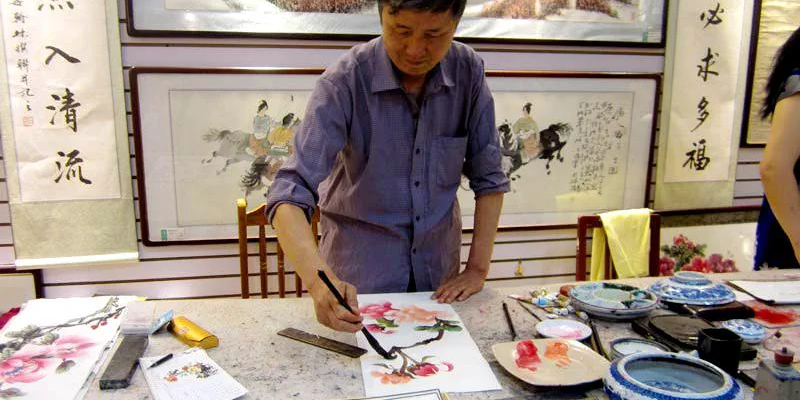
There are two main cultural systems on the globe; the west system and the east system. The west is the most common, while the east primarily refers to the Far East, especially China. Being one of the five main civilizations countries on the globe, China has over 5,000 years of development that greatly impacted the rest of the world. One of the main components of the Chinese culture is a fine art, which started in the yellow river around 5,000 years ago. Notably, Chinese paintings have unique characteristics and spirits that help to define them.
The Main Attributes of Chinese Painting
Chinese paintings acquired their characteristics after years of development. In the earliest days, the Chinese painted on the walls of the tombs using brush, pigment, and ink. Later they started painting on silk clothes and paper. These early pieces of work are very helpful in identifying the main characteristics of Chinese painting.
- Brushes
One of the main differences between Chinese and western painting is that the Chinese ones are mainly made of lines. This fact is associated with calligraphy, which started around 3,000 years. Notably, the methods used to draw lines vary from one school to another. In Chinese art, the main types of lines were iron lines and leaf lines. The iron lines move straight without changing the width, and they were used to draw characters on shells, bells, and metal materials. However, leaf lines had varying width.
Most Chinese painters, as evidenced from the work of top collectors, such as JohnDodelande, opted for freestyle and curved lines as opposed to relying on straight lines. The inspiration to use freestyle comes from their commitment to calligraphy, primarily cursive writings.
- Ink and Pigment
Over one thousand years, painters in China started putting more emphasis on the need to use ink. The first one they turned to was black ink, which was used to provide tone to paintings. Even when the drawing under consideration involved using colors, black was still used to help organize and stabilize the drawings. The use of black appears in line with the western color theory that indicates black to be the basis of all other colors.
- Paper
Most Chinese painters worked on water-resistant silk pieces of clothes. However, things changed latter, and they are started using water-absorbing cotton types of paper. When it comes to composition, painters rely on an increasing quantity of simple and rough strokes as opposed to complex and fine strokes. Indeed, calligraphers are increasingly becoming cursive, and this has greatly impacted contemporary painting. For example, ink work paintings in the 20th century borrowed largely from calligraphers’ use of ink.
These characteristics we have highlighted above highlight the richness of Chinese art and also help to differentiate them from western painting. Other notable characteristics include empty and solid images that are likened to the principles of nothingness and emptiness in Confuciantheory. Indeed, the theory has strongly impacted the production of most works of art in both ancient and contemporary Chinese paintings. In addition to the theory, painters also analogize with mountain peaks, hollow inside, integrity, and humbleness.
 Virtually Travel